
Check San Mateo County Voter Registration
The San Mateo County My Election Info lookup is the most direct way for a local voter to check a registration. It is a self-lookup, not a search box for browsing names. Enter the house number only, the five-digit ZIP code, and the complete birth date. The form submits those details together to find the matching voter record. If county records do not match, the tool may report no record or more than one record instead of exposing possible matches.
| Field | Type | Required | Notes / Format |
|---|---|---|---|
| Your House Number Only | Text | Yes | Use the number without the street name, such as 124 for 124 Main St. |
| Your ZIP Code | Number | Yes | Five numeric digits |
| Birth Date, Month | Dropdown | Yes | January through December |
| Birth Date, Day | Dropdown | Yes | 1 through 31 |
| Birth Date, Year | Dropdown | Yes | Year choices run back to 1890 |
| Look me up | Button | Not applicable | Submits the birth date as one date value |
The county form is shown on the official lookup screen below. View the county’s My Election Info form before entering personal data. Its narrow fields let a voter retrieve personal election information without creating a public name index.
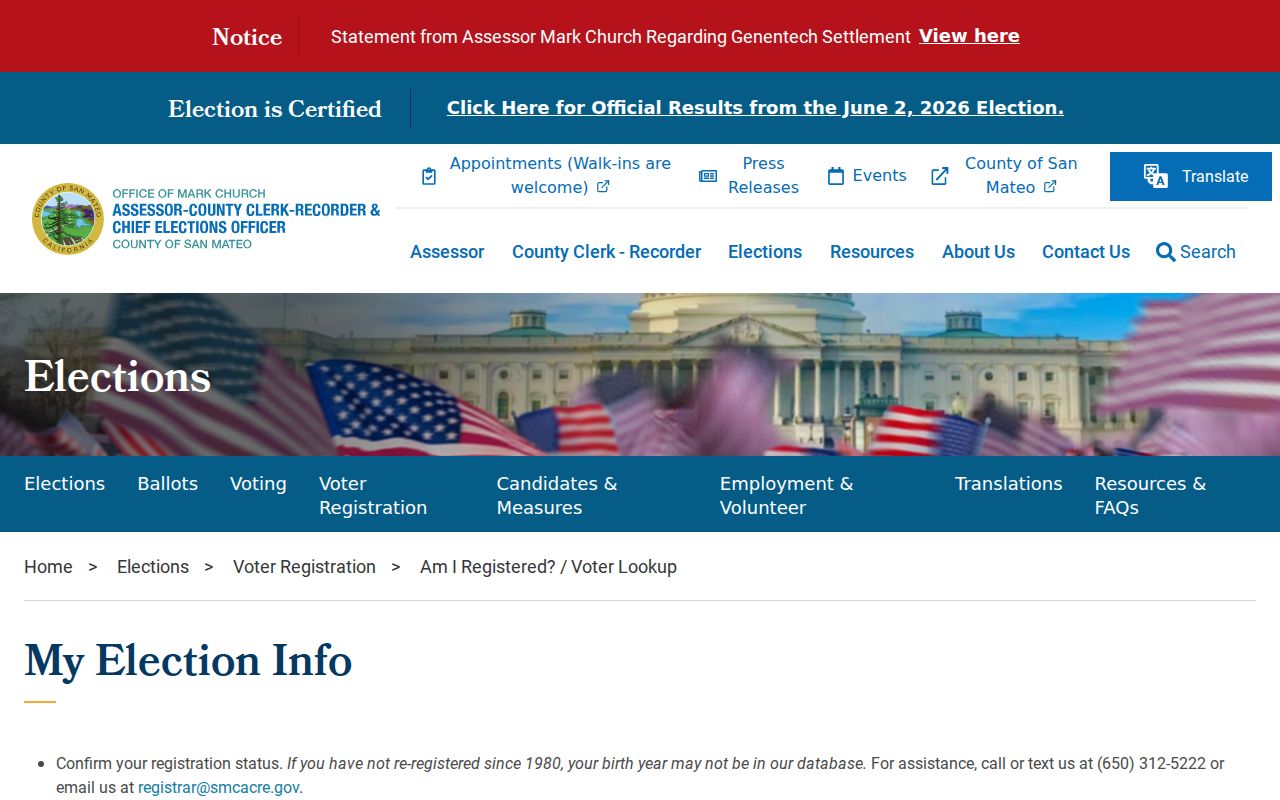
The captured form confirms that a name alone cannot retrieve San Mateo County voter records. A voter may also use the California My Voter Status service as the statewide self-lookup channel.
San Mateo County Voter Lookup Results
A successful match can show whether the registration is active, the voter’s party preference, precinct number, and the districts that contain that precinct. An election selector opens details for a current contest. Depending on the election, results may include the vote-by-mail sent and returned dates, ballot status, ballot style, sample-ballot links, a replacement-ballot deadline, and an early-vote date.
The return screen can also show the last registration date and whether the voter chose the Go Green paperless voter information pamphlet. Voting history records participation, not the choices marked on a ballot. Ballot choices remain secret.
Note: An active status is represented by the county system’s code A, but the public-facing result explains the status in voter terms.
California Voter Records and Privacy
California separates data that an authorized applicant may receive from facts available through a voter’s own lookup. State regulations identify fields that can be supplied for an approved election, scholarly, journalistic, political, or governmental purpose. Access is conditional, not general publication. A supplied file may hold the fields below when the request and intended use qualify.
| Name | May be included for an authorized applicant. |
|---|---|
| Address and contact | Residential and mailing address, phone, and email may be supplied only under restricted access rules. |
| Registration details | County, registration ID, status, date, method, reason, and precinct may appear. |
| Voter details | Party preference, language preference, birth date, gender, and place of birth are among regulated fields. |
| Voting history | Participation by election date and voting method, never ballot selections. |
| Ballot access | Permanent vote-by-mail and voting-assistance request status may appear. |
Confidential by law. Government Code §7924.000 and Elections Code §2194 bar routine disclosure of protected registration data. Driver license or ID numbers, Social Security or unique identifiers, and voter signatures are not released.
Home street address, phone, email, precinct or other registration number, and prior registration information are also confidential outside the access Elections Code §2194 permits. The restricted nature of voter registration is why My Election Info asks for personal facts instead of offering a public surname search.
Request San Mateo County Voter Files
The San Mateo County voter-file information page routes qualified applicants to a written application. Eligible applicants include candidates, ballot-measure committees, and people or groups using the data for election, scholarly, journalistic, political, or governmental purposes. The county cites Elections Code §§2188, 2194, and 2157.2.
- Complete the county application with the requester, organization, contact information, intended purpose, and requested data options.
- Sign with an original signature and attach a current driver license or state photo ID copy.
- Submit the form and fee in person, or mail them to the Registration & Elections Division at 40 Tower Road, San Mateo, CA 94402.
- Allow up to five business days. Approved plain-text, tab-delimited data arrives through secure FTP.
Questions about a request can go to data@smcacre.gov or (650) 312-5222. No refund is issued after the county sends the data.
Review the official county file rules alongside the request steps.
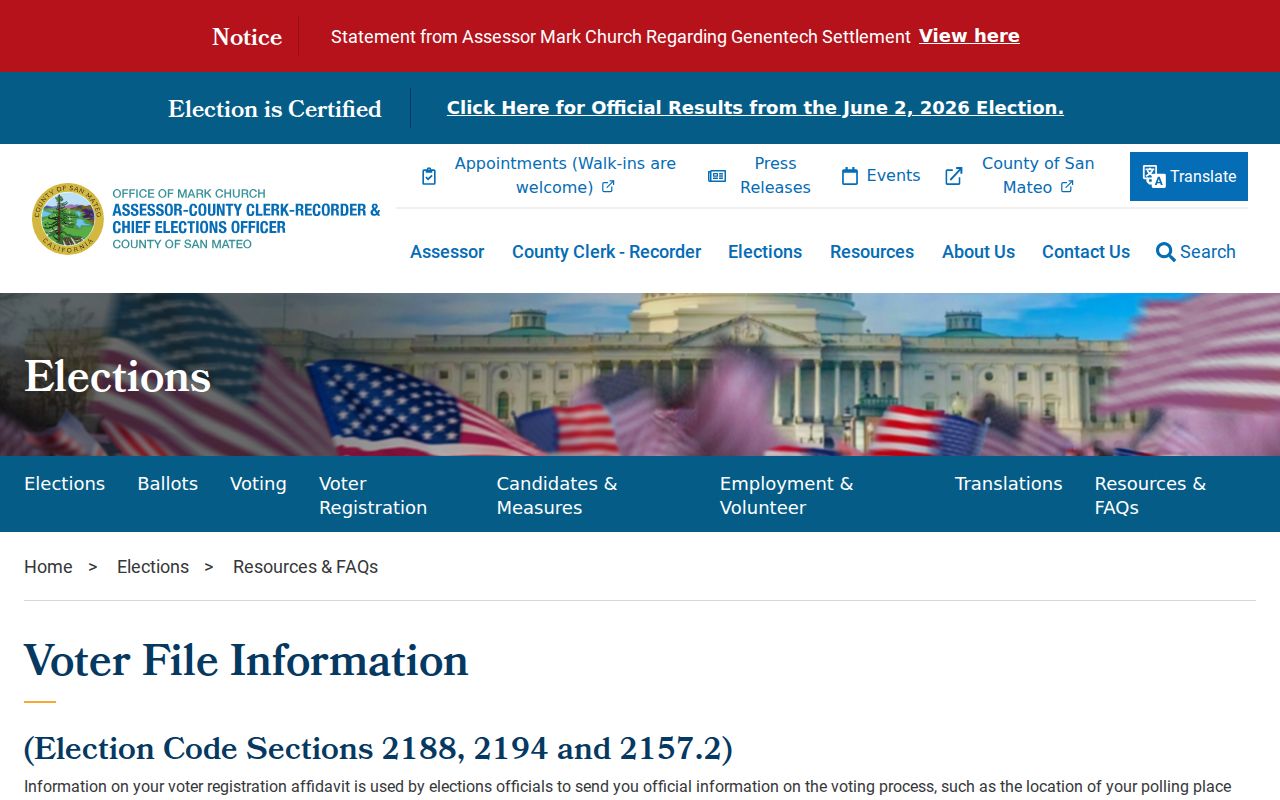
The county page places the application, statutory limits, cost, and contact route together, so applicants can confirm eligibility before paying.
San Mateo and Statewide Voter Rolls
A San Mateo County request serves local needs, while the Secretary of State voter-file process can provide a statewide file or records limited to a county. Statewide data can include voter history and district information when the approved request calls for those additions. The same qualified-purpose rules still apply.
State fees are $15 per 1,000 records, with a $15 minimum and $100 maximum. A request for specific voter records costs $30 each, is capped at 10 voters, and has a $100 maximum. County source agencies may set their own charges, which explains why the San Mateo County schedule differs.
San Mateo County Voter File Costs
San Mateo County charges $125 for each voter information file. A printed list costs $0.50 per 1,000 voters, and the county does not produce printed maps. A certificate of a voter’s registration is listed at $1.50. The application can also request a single data file with five elections of voting history, earlier election history, district or precinct data, vote-by-mail data, and certain paper-list or in-office options.
The official application wrapper pictured below is the county’s access point for the required form. Applicants should use the current county copy because the selections and certifications define what the Elections Division may release.
Open the county voter-file application wrapper to review the form.
The wrapper leads to the application that records the requester’s identity, purpose, signature, file choices, and agreement to protect the data.
San Mateo County Voter Record Limits
Authorized access does not grant free reuse. Elections Code §2194 bars personal, private, commercial, advertising, solicitation, marketing, sale, harassment, and unauthorized internet display. The county form also forbids unsecured exposure and transfer to another person or group without a new application and written approval.
Use carries legal duties. Misuse of voter registration information can be a misdemeanor under Elections Code §18109. Protect each file and report threats or harassment to law enforcement.
These limits apply even when a recipient lawfully obtained the data. The county Elections Division or Secretary of State can answer access questions. The broader records-request framework is covered under San Mateo County public records access, but it does not override voter-file statutes.
Confidential San Mateo County Voters
San Mateo County Elections explains confidential voter status for eligible voters facing life-threatening circumstances. The California Secretary of State’s Safe at Home program provides a substitute mailing address and can support confidential registration. Elections Code §§2166 and 2166.5 govern key protections.
This protection changes what can appear in election records and how an affected voter works with the office. It is not an opt-out that turns every official record private. Eligible participants should request the Confidential Voter Registration Form through the county rather than placing sensitive facts into a routine data inquiry.
Note: Safe at Home protection follows a formal state and county process; a standard voter-file application cannot bypass a protected address.
Historic San Mateo County Voter Registers
Old voter rolls serve a different purpose from the current file. FamilySearch identifies San Mateo County Great Registers for 1867–1869, 1871–1872, and 1875–1877, plus a broader California Great Registers collection covering 1866–1910. Its county research material also points to voting records from 1866–1898 and naturalized-voter cards.
Great Registers can connect a name with a residence or precinct and may preserve naturalization facts. That makes them useful for family history and for distinguishing people with the same name. Some originals were microfilmed at the California State Library in Sacramento, so historical research may require FamilySearch or an archive rather than the current county Elections Division.
San Mateo Voter Privacy in 2026
California expanded protected-voter rules on January 1, 2026. Secretary of State memo CC/ROV #25168 implements AB 1392 and Elections Code §2166.9, which protects the residence address, phone number, and email of qualifying elected officials and candidates.
The change is a timely reminder that a voter roll is not a public name-search directory. Access rules can depend on the person, field, applicant, and stated purpose. Anyone using an older application or past data extract should check current county and state instructions before assuming the same fields remain available.
Choose a California Voter File Channel
Use My Election Info for a San Mateo County voter’s own status and election details. Apply to the county for a local voter file, printed list, certificate, or listed in-office option. Use the Secretary of State when an approved purpose calls for statewide or county-specific data through the state process.
Each route asks a different question. The self-lookup confirms one voter. The county and state applications test the requester’s eligibility, purpose, identity, requested fields, and ability to secure the data. For records that fall outside these current channels, historical Great Registers and archival sources are the proper fallback.