
San Mateo County Public Records Custodians
No single office holds every public file. San Mateo County ACRE joins assessor, clerk-recorder, and elections functions, yet each division has its own access rules. Courts, the Sheriff, cities, and state agencies remain separate. The table identifies the first stop and the fallback when the web does not provide the file.
| Record group | Official keeper | Web access | Copy or fallback route |
|---|---|---|---|
| Deeds, liens, and recorded maps | County Clerk-Recorder | RecorderWorks index, 1985 to present | Public terminal, counter viewing, or copy order |
| Civil, criminal, probate, and family cases | San Mateo Superior Court | MIDX index and Odyssey Public Portal | Records Management by mail or court clerk |
| Assessment, tax, and parcel maps | Assessor, Tax Collector, and county GIS | Address, APN, tax, and map tools | Assessment roll at Assessor counter |
| Birth, death, and marriage certificates | County Clerk-Recorder or CDPH | No open county name index confirmed | In person, mail, or approved online vendor |
| Planning, building, and code files | County or the relevant city | Accela or a city permit portal | Agency request form, email, mail, or counter |
| Custody and police agency files | Sheriff or CDCR | County locator and state CIRIS | Sheriff request page, report form, or phone |
California law does not turn every government-held item into an open file. Sealed cases, adoption and juvenile matters, protected motor vehicle data, confidential marriage files, and some law-enforcement material have separate limits. Voter files also have purpose and disclosure restrictions. Start with the rules for the record itself, not just the general California Public Records Act.
San Mateo County Recorder Index
RecorderWorks is the county's official Grantor/Grantee index for recorded property documents from 1985 forward. A grantor transfers an interest; a grantee receives it. Results can point to deeds, liens, judgments, notices of default, trustee deeds, affidavits of death, maps, and transfer-on-death deeds. Older material may require a document number, recording date, or help at the Clerk-Recorder office.
| Search control | How the county portal uses it | Format or limit |
|---|---|---|
| Party role and name | All, Grantor, or Grantee; person or business | Last name first; partial match is available |
| Date range | Narrows name or document-type results | MM/DD/YYYY |
| Document number | Opens a known recording | Full number usually starts with a four-digit year |
| Document or map type | Filters deeds, liens, maps, and other classes | Dropdown choices vary by mode |
| APN | Connects a parcel to recorded instruments | Nine digits with no dashes |
| Book and page | Locates an older indexed reference | Separate search tab |
After opening a document number, select a name in the left menu to expand other indexed documents tied to that party.
Note: RecorderWorks is a reference index, so confirm the relevant instrument through the Clerk-Recorder before relying on its legal effect.
Why San Mateo Records Omit Images
An online hit is not the recorded document. San Mateo County deliberately omits document images from RecorderWorks for privacy, even though the underlying instruments are public records. The county also says owner names may be left out of files researched online to reduce identity-theft risk. This is why a complete deed search often ends at the County Clerk-Recorder counter rather than on the web.
Documents may be viewed without charge on public terminals during normal business hours at 555 County Center in Redwood City. Copies can be bought at the office or through the recorded-document copy process. This split protects online data while preserving access to the official file. It also prevents a common mistake: treating a short index line as if it shows every term, signature, legal description, or recording mark on the instrument.
Index versus image. The index tells you that a filing exists. The image is the filed instrument, and a certified copy carries the custodian's formal authentication.
San Mateo County Court Records
The MIDX case index is the quick name-search layer for appeals, civil, criminal, family law, probate, and small claims matters. Person searches require at least two characters in each name field, while a business search requires three. A trailing asterisk works as a wildcard. Filing-date searches may span no more than five calendar days. MIDX shows index information, including case number, party type, case name, and file date.
The Odyssey Public Portal requires no registration and adds registers of actions for non-confidential, non-sealed cases. It may display allowed documents, but family law documents are not displayed. Adoption, juvenile, and mental-health matters stay offline. Converted cases from 2000 to mid-2016 use older prefixes; later cases generally start with a filing-year and case-type code.
For a copy, use Superior Court Records Management rather than MIDX. Mail requests are accepted, clerk terminals remain an option, and criminal cases before 1993 require contact with the Criminal Court Clerk. The court does not research a file for the requester.
San Mateo County Property Geography
Record jurisdiction changes across San Mateo County. Unincorporated parcels use the county Accela permit search, while incorporated places may run their own planning and building systems. The City of San Mateo, for example, publishes a portal route that supports address, date, permit number, parcel number, and map searches. A county request will not automatically reach a city-held permit file.
Property work is also parcel-first. The secured property tax lookup accepts an address or assessor's parcel number, called an APN. Planning GIS recommends the nine-digit APN format and says to remove dashes and spaces when searching. The Property Maps Portal links parcel geometry, map records, and land layers. A public owner-name web search was not confirmed, but the current assessment roll is open for inspection at the Assessor counter.
That city-county split is a practical geography rule. Identify the jurisdiction before filing.
Note: An address may fail in the map tool, while its APN can still connect tax, GIS, permit, and recorder records.
San Mateo County Vital Records
The County Clerk-Recorder issues birth and death copies for events in San Mateo County and marriage certificates for licenses bought in the county. There is no confirmed open county name index. Requests go in person, by mail, or through the county's approved online vendor. Telephone orders are not accepted. Recent birth and death records first become available through county Vital Statistics before moving to the Recorder.
California Health and Safety Code §103526 separates authorized from informational certified copies. An authorized copy can establish identity and requires an eligible relationship plus a sworn statement. A mailed sworn statement must be notarized. Other requesters may obtain an informational copy marked as not valid to establish identity, subject to the record's rules. The county redacts signatures and Social Security numbers.
County fees are $34 for birth, $26 for death, and $19 for a public marriage certificate. Pre-1966 records need 24 hours' notice because they are off site. Mail payment must use an accepted check or money order. CDPH Vital Records is the statewide fallback.
San Mateo County Records Desks
Use the office that owns the source file. County Center in Redwood City houses the main local counters, while state systems handle statewide custody and professional data. Calling ahead is wise when an older file may be off site or when the desired case category has limited online access.
County Clerk-Recorder
555 County Center, 1st Floor
Redwood City, CA 94063
(650) 363-4500
County Assessor
555 County Center
Redwood City, CA 94063
Public roll at front counter
The Treasurer-Tax Collector at County Center uses 866-220-0308 for tax records. Sheriff requests and state systems have their own routes.
San Mateo County Business Records
Business evidence is split by filing type. The Clerk-Recorder keeps fictitious business names, or FBN filings, which can also be searched and ordered at its office. County licenses cover unincorporated San Mateo County, not every city. California SOS bizfile handles entities, while state boards verify professional licenses.
The official Fictitious Business Name Search offers FBN name, file number, and filed-date modes, with partial matching where supported.
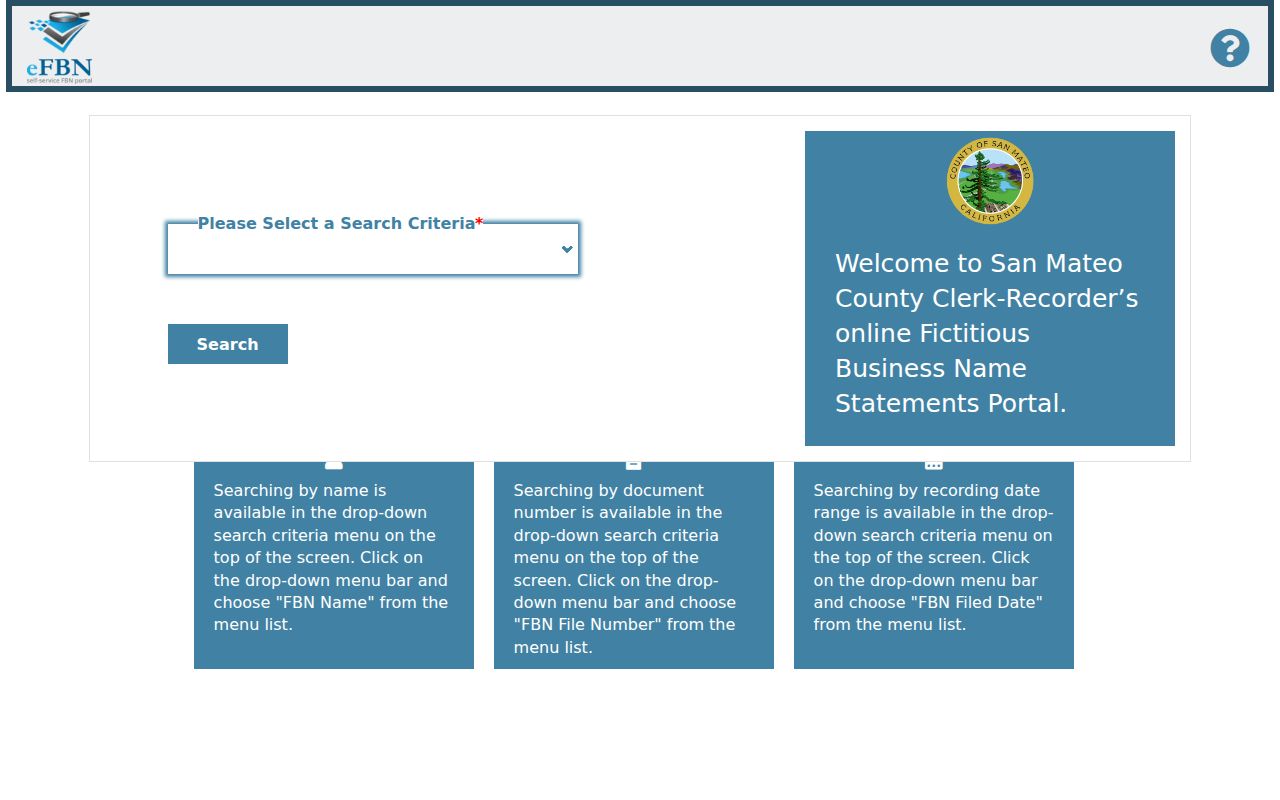
The screen separates a trade-name query from a file-number or date search. For an unincorporated-area license, the San Mateo County Business License Search accepts business name, address, type, account number, state license number, and start-date range.
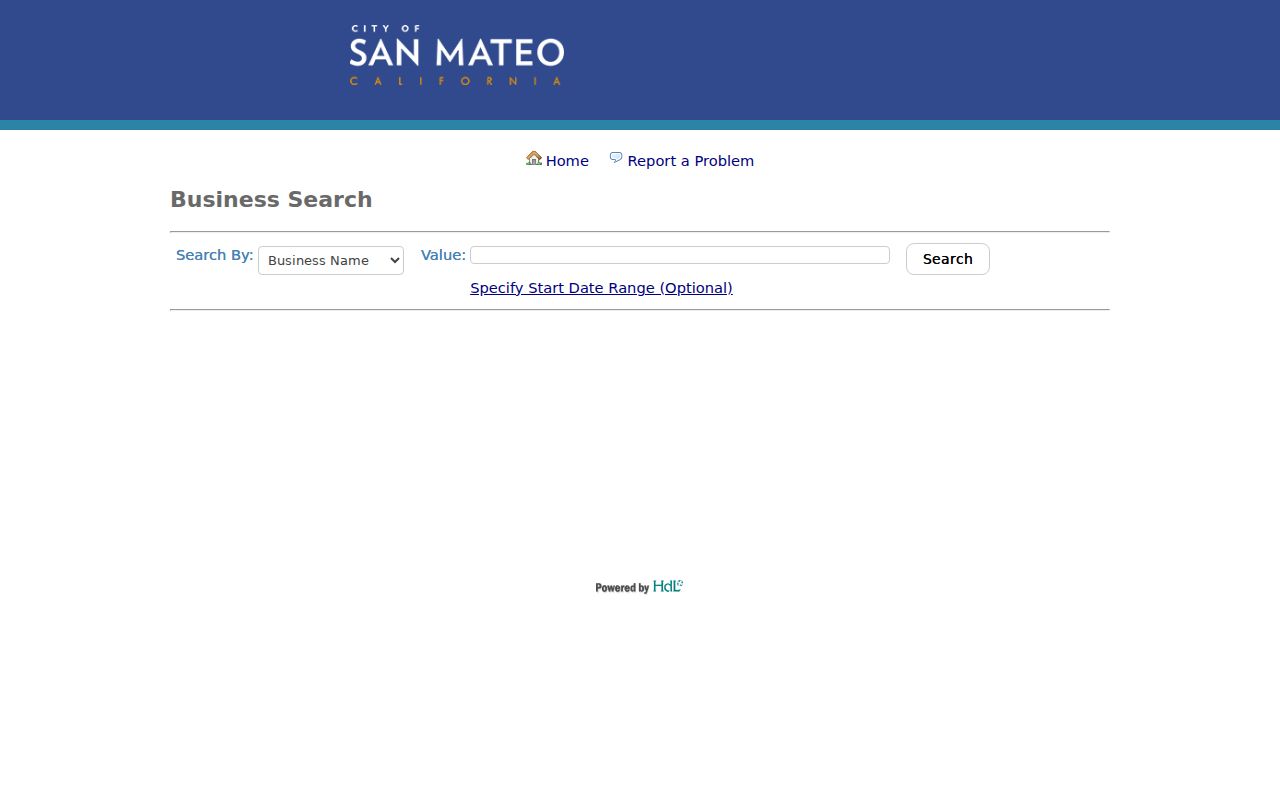
Those fields let a requester distinguish a local operating license from an FBN filing or state entity record. They also make the portal useful for seller verification and scam avoidance.
San Mateo County Custody Records
The Sheriff's Corrections Division links a county Inmate Locator with current custody details such as facility, pending charges, custody status, next court date, and bail amount. If the locator fails, Maguire Correctional Facility provides a phone fallback at (650) 363-4000 extension 6070; the caller needs the person's name and correct date of birth. California CDCR's CIRIS covers state custody, while the federal Bureau of Prisons holds federal records.
Police reports and CAD, or computer-aided dispatch, records follow a different route. Submit a focused request through the Sheriff public records request page or use the Criminal Records Bureau's report and CAD forms. Investigative facts, victim details, juvenile information, and safety-sensitive material may be withheld or redacted. The California DOJ Megan's Law registry separately publishes information allowed by Penal Code §290.46. Registry information must never be used to threaten or harass anyone.
California Access Rules and Exemptions
The California Public Records Act, Government Code §7920.000 and following, governs agency records. Any member of the public may make a request, regardless of state residency. Under §7922.535, an agency generally has 10 days to decide whether it holds disclosable material and notify the requester. Written notice may extend that determination by up to 14 days for unusual circumstances. A determination is not the same as delivery on the tenth day.
Direct duplication costs may be charged. Ordinary review and search time generally are not copy fees, though special programming or data extraction can carry a lawful charge. The Act does not override the court's case-file rules, vital-record eligibility, voter-file statutes, sealed proceedings, Safe at Home address protection, or motor vehicle privacy law. An exemption is a legal reason to withhold all or part of a responsive record.
San Mateo County Copy Costs
Online indexes are often free, but official copies are not. Superior Court research lists $0.50 per side, $40 for certification, $50 for exemplification, $1 per side to compare a copy with the original, $15 for a search lasting more than 10 minutes, and $10 for off-site retrieval. Certification means the custodian formally attests that a copy matches the court record. Verify current charges with the court before ordering.
For recorded instruments, locate the document number in RecorderWorks before contacting the Clerk-Recorder. That cuts down office research and identifies the exact filing to copy. For Planning and Building files, the county accepts its PRA form by email, mail, or in person at the Permit Counter. Building plans add an authorization form and an affidavit for reproduction. Court copies go to Records Management, and Sheriff records stay with the Sheriff.
Older and offline records need a narrow date, party name, address, APN, case number, or document number.
Note: A targeted request is easier to locate, review, price, and release than a broad demand for every file mentioning a name.
Request San Mateo County Public Records
Use a formal agency request when a county or city department has not published the needed file. Describe an existing record rather than asking the office to answer a question or conduct research. Include enough detail to locate it, ask for electronic delivery when practical, and state whether inspection would meet the need.
- Identify the custodian. Decide whether the file belongs to ACRE, the Superior Court, Sheriff, Planning, a city, or a state agency.
- Check its direct access channel. Use the index, office terminal, counter, copy form, or mail route assigned to that record class.
- Write a focused request. Supply names, dates, addresses, APNs, case numbers, or document numbers and describe the desired format.
- Review the response. The agency should identify responsive material, applicable charges, and any legal basis for withholding or redaction.
- Narrow or follow up. Clarify an overly broad request, arrange inspection, pay lawful copy costs, or challenge a denial through the proper process.
- Custodian
- The office responsible for keeping and releasing a record.
- Index
- A searchable description that points to a file but may not include the file itself.
- Certified copy
- A reproduction formally authenticated by the office that holds the original.
- Redaction
- The removal of protected details from an otherwise releasable record.
Lawful personal use. Access records for legitimate family, property, probate, safety, or civic needs. Never use a record to stalk, threaten, harass, or harm another person.